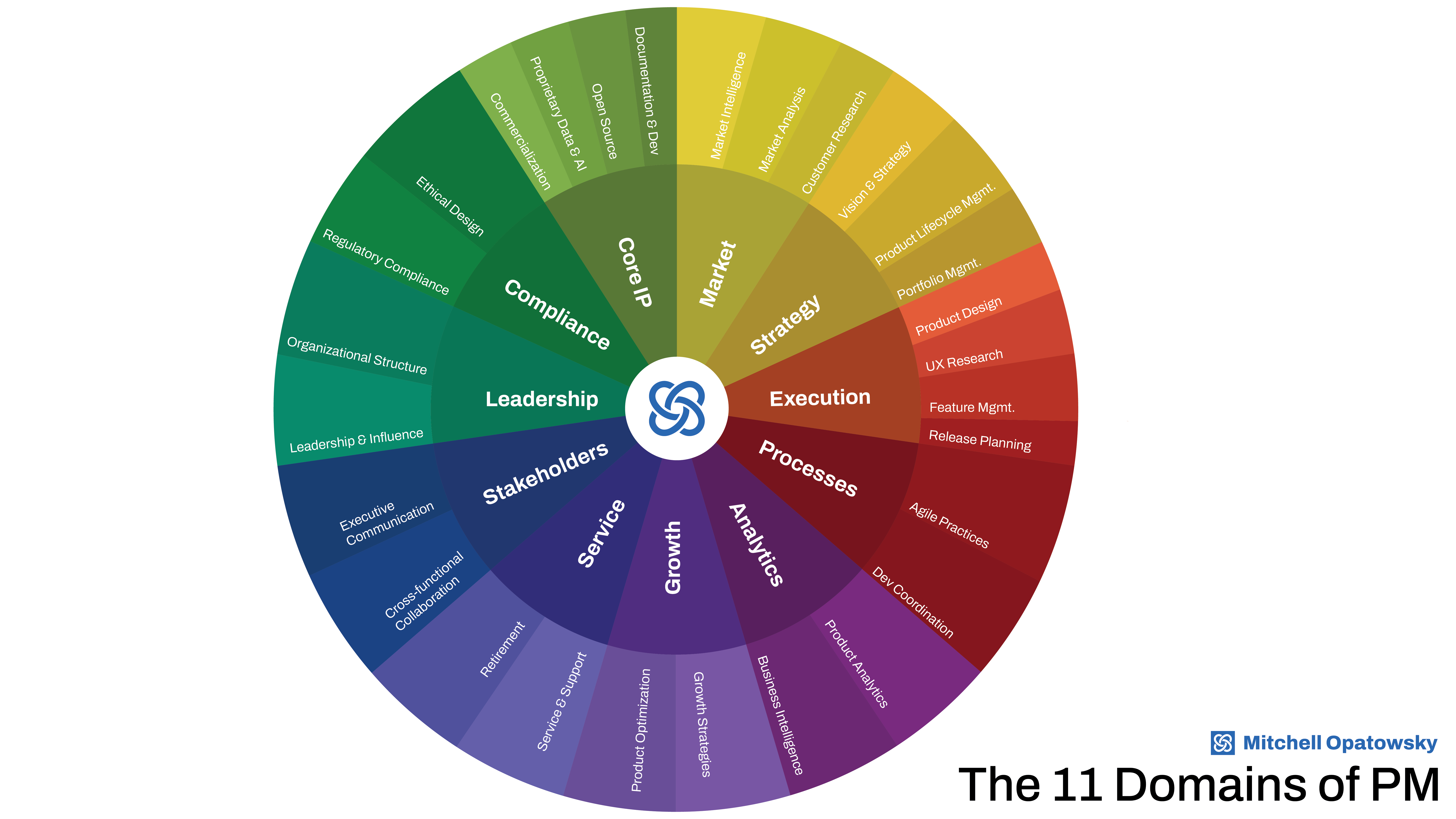
The 11 Essential Domains for Product Management in Startups
A comprehensive guide to the core competencies every product manager needs to master, from user research to metrics and analytics.
Product management is evolving fast. This interdisciplinary profession delves into many competencies, from influencing stakeholders to scaling growth to managing across teams. But how do you keep up with it all?
Breaking it down was time-consuming. In my article, “The 11 Essential Domains for Product Management in 2024 and Beyond”, I contextualize this world so you can master it too:
✅ How to leverage Market Intelligence to stay ahead of shifting trends
✅ Strategies for Stakeholder Management and leading teams without direct authority
✅ Building Proprietary Innovation through AI models and proprietary databases
✅ Ensuring Regulatory Compliance while driving Ethical Design
✅ The importance of Product-Led Growth and Retention Optimization for scaling
ProductManagement #Innovation #Growth #Leadership #AI #Startups #Agile
Draft Introduction
In this article, you'll learn:
- The 11 core domains that every product manager must understand to navigate the evolving landscape of product development and growth in 2024 and beyond.
- How these domains—ranging from Market Intelligence and Product Strategy to Data Analytics and Regulatory Compliance—interconnect to create a holistic framework for modern product management.
- Why mastering Stakeholder Management, Leadership and Influence, and Service and Product Retirement is crucial for managing cross-functional teams and maintaining long-term product success.
- The importance of Proprietary Innovation and Open Source Strategy in shaping your product’s competitive edge, and how these fit within the broader context of commercialization and platform development.
- How Growth and Optimization strategies can elevate your product’s lifecycle, ensuring continuous improvement through data-driven decision-making and product-led growth tactics.
In my piece Chaos to Clarity, I defined product management versus project management. It often gets confused in the professional and especially in the startup context.
Product Management is about vision and strategy, the blueprint, the high level thinking behind what product to build, why it matters, and who will use it. Product managers obsess over customer pain points, market research, and feature prioritization. Project management focuses on execution of the plan, while product management is focused on strategizing the plan, what the end goal is why we’re going that way in the first place.
A product manager’s job is to:
- Understand customer needs and translate them into features or products. You’re sitting in on customer interviews and asking about pain points.
- Set the product roadmap, guiding the team’s efforts for the next 6-12 months. You’re sketching out product development releases.
- Prioritize features based on value, market trends, and customer feedback. You’re scoping new features and determining which will create the most value with the least resources based on the market opportunity.
- Make sure the product aligns with the company’s vision and long-term goals.
My goal with this article is to introduce Hierarchical Taxonomy Levels to describe product management. I split this between the following
My Rationale is like so. This hierarchical structure allows for a systematic organization of product management expertise, facilitating:
- Skill Mapping: Enables precise identification of skills and knowledge areas required for different roles within product management.
- Curriculum Development: Aids in creating comprehensive training programs and educational materials for product managers.
- Performance Evaluation: Provides a framework for assessing product managers' proficiency across various domains and competencies.
- Career Progression: Helps in defining clear career paths and progression criteria within the field of product management.
By utilizing this taxonomy, you can appreciate a standardized lexicon for evaluating your own product management expertise. This standardization is crucial for maintaining consistency in hiring practices, professional development, and cross-functional communication within the product development ecosystem.
For the purposes of simplification, I’ll mostly stick to describing the Domains, Subdomains, and Competencies, and save techniques for future articles where we can dive more into the specific applications.
Domain: Market Intelligence and Customer Understanding
This category focuses on understanding the market landscape and customer needs.
One might refer to David Phelps’ "Three Moats in Web3" or James Currier’s “The 7 Powers” to understand moats.
Domain: Product Strategy and Planning
Domain: Product Development and Execution
This category focuses on the tactical aspects of bringing a product to market.
Domain: Agile and Development Processes
This category covers the product manager's role in development methodologies.
Domain: Data and Analytics
This category focuses on using data to drive product decisions.
Domain: Growth and Optimization
This category focuses on growing and improving the product post-launch.
Domain: Service and Retirement
These are critical for ensuring that customer feedback is funneled back into product improvement, and that lifecycle management is aligned with both market needs and internal resource planning.
Service and support stage
Product lifecycle management doesn't finish once the product is launched and people have bought it. You must provide ongoing customer support, including customer service, warranties, and repairs.
In some cases, this also includes organizing training or creating tutorials on how to use your product.
New business owners often calculate the costs of production and marketing but forget to add in the cost of service and support. These costs can quickly add up, depending on the complexity of your product or your target group.
However, this stage is essential for customer relationship management and building trust. As you already know, selling to an existing customer (who was satisfied with your product or service) is much easier than acquiring a new one.
Therefore, investing in providing great customer support may lead to significant cost savings in the long run.
Retirement stage
There are various reasons for product retirement and withdrawal from the market. Maybe the product is outdated or there's no more demand for it. Maybe the competitors have come up with a much better solution. Or maybe you simply want to switch to something else and build a new product.
In any case, someone has to manage the so-called end of life of the product, including public announcement, clearing remaining inventory and recycling or re-purposing.
Successful products often get enhanced with new features or a better design and launched again. A classic example would be the iPhone, where each generation represents a similar product, just improved with new technology and innovative features.
Domain: Stakeholder Management
This category covers the interpersonal aspects of product management.
Domain: Leadership and Organizational Influence
This would elevate their importance and clearly differentiate between tactical stakeholder management and strategic leadership dynamics. These skills are often cross-functional, cutting across multiple domains of influence.
Domain: Regulatory Compliance and Ethical Design
Essential for modern product management, particularly in industries such as AI, Web3, fintech, healthcare, and any field where legal, regulatory, and ethical considerations are paramount. This domain would cover the competencies needed to navigate regulations and ensure ethical product development while avoiding legal risks and maintaining consumer trust.
Domain: Proprietary Innovation and Commercialization
Capture the essence of ensuring that a product not only serves its market but also secures its competitive advantage through proprietary assets, unique algorithms, and extensibility via open-source or platform strategies. Encapsultes IP planning, data capture, AI enhancement, and open-source strategy.
Market Analysis:
Market Intelligence:
In essence, market analysis can be seen as a tool or method that contributes to the broader practice of market intelligence. Market intelligence provides a more comprehensive, ongoing view of the entire market ecosystem, while market analysis tends to be more focused and project-specific. Both are valuable for businesses, but they serve slightly different purposes and operate at different scales.
Sources
[1] https://improvado.io/blog/how-to-perform-market-analysis[2] https://www.questionpro.com/blog/market-intelligence/[3] https://www.entropik.io/blogs/market-intelligence[4] https://www.shopify.com/blog/market-analysis[5] https://www.britopian.com/data/market-intelligence-vs-market-research/[6] https://www.linkedin.com/advice/1/what-key-differences-similarities-between-market[7] https://cognition-solutions.com/perspective/market-intelligence-vs-market-research/[8] https://skai.io/blog/market-intelligence-vs-market-research/
Writing
Market Intelligence and Customer Understanding is the foundation that will shape every one of your decisions, from strategy to execution. Without it, you’re flying blind, making moves based on assumptions rather than insights. I’ve been there—thinking I understood the market trends, only to realize too late that I discounted the impact that macro changes were pushing back against the market. The regulatory landscape shifted beneath the team and I, and we did not sufficiently budget in our fundraising strategy to be able to pivot. It’s like setting sail without a compass—no matter how well-built your ship, veering off the trade winds could leave you stranded in the ocean. You need momentum.
Market intelligence isn’t a static process. It’s continuous, layered, and requires deep dives into both external factors and customer behaviors. Trends evolve, consumer preferences shift, and competitors reposition themselves—if you’re not keeping up, you’re falling behind.
Secondary research must be utilized. You’ll need to tap into news aggregators, market round up Substacks, get round up newsletters, skim over podcast guests and conference vendors—oh god, and even open up Twitter and LinkedIn. Yes, platforms like Gartner and Statista give you the bird’s-eye view of your industry, laying out macro trends and big-picture dynamics—but you’re paying a hefty premium to dig down deeper. Trend and narrative analysis is so important I’m going to publish a follow up digging into the big brain strategies to gauge the emergence and ongoing strength of them. In particular, I’ll give attention to Google Trends, Cogent InCights, Exploding Topics, Brandwatch Analytics, Semrush, Ahrefs, Treendly, and Pinterest Trends—but we’ll come back to that.
Relying on secondary research alone is like reading the news—you know what’s happening, but you don’t know how it affects you personally, or necessarily where to apply it. You’re downloading new information, but not practicing it. That’s where primary research steps in. Getting into the trenches with user interviews or focus groups adds the “on-the-ground” perspective. You want to have ears inside with potential customers giving you direct, unfiltered insights that competitors often overlook. Crucially, you’ll need to be able to ask questions in a non-leading way. You need to listen to the source, and you need to do it in a scaleable way. You’ll want to dedicate time to the most qualified sources and will need to establish a process to qualify them.
Segmentation is crucial because you can’t aim for everyone anymore—nobody has the budget or the bandwidth for that. Think of segmentation like targeting in archery: the more precise your aim, the better your shot. Whether you’re using demographic breakdowns, psychographic data (interests, values, attitudes, personality traits, and lifestyle choices), or behavioral analytics tools like Amplitude or Mixpanel, segmentation ensures you’re focused on the right customer segments with precision. For example, RFM analysis (Recency, Frequency, Monetary Value) digs into customer behaviors, helping you figure out who your most valuable customers are—not just on a surface level, but in a way that reveals who will spend the most or stick around the longest. Conduct RFM analysis at regular quarterly or annual intervals, to identify at-risk customers and tailor retention strategies, and before launching new promotional campaigns.
Then comes the subdomain of Customer Journey Mapping, which is like plotting out the quest tree for your heroes. A customer’s journey isn’t merely buying the product—it’s about understanding their full experience, from the moment they become aware of your brand, to the moment they consider using it, to what happens after they’ve used it, to what happens when they’re fully done. You need to think through those triggers, the roadblocks, where they’re delighted, and where they might fall off entirely. Techniques like Touchpoint mapping and funnel visualization help you spot pain points or gaps in the journey. Understanding exactly where customers fall through the cracks allows you to patch those leaks before too many prospects disappear.
Finally, you have competitive analysis. This isn’t just about watching your competitors from the sidelines; it’s about dissecting their playbook. Think of it like reverse-engineering your rival’s product—you’re not just interested in what’s on the surface, but what’s under the hood. Techniques like Porter’s Five Forces, Quadrant Mapping, and the Blue Ocean Differentiation Canvas give you structured frameworks to break down their strengths, weaknesses, and strategies. The real art is finding out where they’ve left the door open. Utilize quadrant positioning maps to communicate findings to the team. Maybe their pricing model is a bit too aggressive, or their messaging doesn’t quite resonate with a particular audience, or their distribution efforts are missing a segment of the market. Exploiting those weaknesses is how you stay ahead.
Product Strategy and Planning is where the vision for your product gets translated into an actionable roadmap. It’s the stage where you lay out the long-term game plan and determine how your product fits into the broader market. I’ve learned that if you don’t anchor your product strategy in reality—balancing ambition with feasibility—you’ll end up chasing moonshots without ever lifting off the ground.
One of the most important tools in this domain is Strategic Roadmapping. Think of it as your navigation chart—it’s not enough to know where you want to go; you need to plot out the course, accounting for potential storms and obstacles along the way. Whether you’re using OKRs (Objectives and Key Results) to set measurable goals, or visualizing your milestones with Gantt charts, the key is to keep your team aligned and moving forward. You may find yourself having to pivot or reprioritize large-scale efforts as new opportunities arise or unexpected challenges emerge. I’ve often found that initiative backlogs in Jira, Aha!, or even in the OKR platform are invaluable here, especially in fast-moving industries. The initiatives in this backlog aren’t just tactical tasks but larger, strategic moves that require cross-functional coordination. They often include major projects such as entering new markets, developing new product lines, or exploring new business models. You might prioritize initiatives based on factors like business impact, resources, or long-term alignment.
Another crucial aspect of strategy is Business Model Development. This is where you figure out how your product will generate revenue, scale, and sustain itself. It’s like building the engine of your car—you can design the sleekest vehicle on the road, but if the engine can’t deliver, you’re not going anywhere. The BMC will help break down the components of your business model, from value propositions to cost structures. As part of my own proprietary Rapid Prototyping Methodology (RPM), and from looking at that stupid blank canvas more times than I can count, I’ve developed the BMC v3.1, and will likely share it in the future.
As you develop your product positioning, remember that your customers need to see not only what your product does, but why it’s uniquely suited to them. In the RPM, the Value Proposition Canvas exercise is one of the first things you run to help you focus on clarifying why you’re doing what you’re doing, mapping customer’s pains to potential gains, so you can position your product as the solution they’ve been waiting for.
But positioning is more than just product messaging. It’s about differentiation, and one of my favorite tools here is Blue Ocean Strategy—it forces you to look beyond competing on features and instead focus on creating uncontested market space. Honestly, it’s such an important tool, I decided to list it twice. You might as well as build a new path through the forest if everyone else is fighting for control of the foot traffic of the same trail.
Market Entry Strategy is the final piece of the puzzle. It’s how you bring your product into the world and get it in front of your target audience. A strong Go-to-Market (GTM) strategy isn’t just about launching; it’s about sequencing. You need to decide which segments to target first, what marketing channels to prioritize, and how to build momentum. One of the most challenging launches I managed was balancing a phased rollout while making sure we didn’t alienate our early adopters. By rolling out features gradually and gathering feedback along the way, we were able to fine-tune the product before pushing it to a broader audience.
Product Development and Execution is a fast-paced, high-stakes part of product management. It’s where strategy meets reality, and where your ability to coordinate teams, manage complexity, and execute efficiently directly impacts your product’s success. Without clear processes for scoping, prototyping, prioritizing, and releasing features, your product will quickly fall behind—or worse, collapse under the weight of its own ambition.
It’s important to think of Product Development and Execution not as a single step but as a continuous cycle of building, testing, and iterating. Your roadmap might look clean and linear, but reality is far messier. Features need to be scoped, prototypes need testing, and releases need careful planning.
One of the most critical tools in this phase is feature scoping. Think of it like crafting a blueprint—you’re defining the exact specifications, constraints, and goals for each feature before it’s built. This is where you’ll decide what’s essential to the product’s success and what’s just a nice-to-have. It’s easy to get caught up in adding “just one more feature,” but this is where scope creep can quickly derail a project. In practice, I’ve found using a MoSCoW prioritization framework (Must have, Should have, Could have, and Won’t have) is an effective way to maintain focus. It helps teams make tough decisions by forcing them to categorize features based on necessity, ensuring that the most impactful ones are delivered first.
After the scope is set, the next step is wireframing and prototyping. Think of a prototype as the first draft of your feature—a quick, interactive model that allows you to gather feedback before you invest serious development time. Whether you’re creating a low-fidelity prototype (like a clickable wireframe) or a high-fidelity interactive mockup, this stage is about experimentation and early validation. Prototyping saves you from the “build it and hope they come” mentality. It’s like testing a new recipe, you wouldn’t prepare the final dish for an important dinner without tasting it first. Fortunately, some of the new AI tools & plugins across Figma to the Adobe Suite are making this so much faster, and I’m going to return back to these techniques in upcoming playbooks.
Once you’ve validated your prototype, it’s time to move into full development, where feature prioritization becomes essential. You can’t build everything at once, and trying to do so will spread your resources too thin. Here’s where frameworks like RICE (Reach, Impact, Confidence, and Effort) come into play. This method helps you prioritize which features to build first by considering how many users a feature will affect, its potential impact, your confidence in its success, and the effort it will take to build. It’s a balancing act—you need to get high-impact features to market fast, but you also need to be realistic about your team’s capacity.
During development, the collaboration between product, design, engineering, marketing, and sales teams becomes paramount. But development is never a straight path—it’s iterative. This is where agile processes really show their value.
Building a feature is only half the battle. You need to release it in a way that doesn’t overwhelm your users or cause disruptions. This is where release planning comes in. Think of it like launching a rocket—you don’t just hit the ignition button and hope for the best. You plan the trajectory, test every system, and have contingencies in place for anything that might go wrong. A structured release strategy might involve phased rollouts or beta releases, where you release the feature to a smaller group of users before going wide. Feature flagging is a particularly useful technique here—it allows you to turn features on or off for different user segments, enabling you to test in real time without disrupting the entire user base. Tools like LaunchDarkly or Split.io are great for managing feature flags and ensuring a smooth, controlled release.
Once the feature is live, it’s critical to monitor its performance through post-launch tracking. This is your feedback loop. You’ll want to track adoption rates, user engagement, and any issues that arise so you can respond quickly. Monitoring platforms like Posthog or Hotjar give you visibility into how users interact with new features, identifying any usability issues or unexpected friction points.
I always find it’s essential to set up clear KPIs for new features before they launch—whether it’s the number of users adopting the feature, an increase in engagement, or a decrease in churn. Having these benchmarks in place means you’re not guessing whether the release was a success or not.
As I discussed in Scrum to PMP, Agile isn't just a buzzword that haunts your dreams—it's a mindset that nothing is ever “done”. It’s also the method that can make the difference between hitting your targets and burning out halfway through. As I discussed in that article, larger organizations or those needing to coordinate multiple teams, Scaling Frameworks like SAFe (Scaled Agile Framework) or Scrum@Scale become invaluable to synchronize efforts.
At the heart of Agile is Sprint Planning. Think of each sprint as a tactical mission—you need clear objectives, defined resources, and the discipline to stay within scope. In sprint planning, teams take the larger strategic goals laid out in the roadmap and break them down into actionable tasks. This is where you define the sprint goals, estimate the workload, and determine your team’s capacity. I’ve seen teams falter by underestimating this step, thinking they could wing it, but this is where velocity can tank if you’re not careful. A capacity planning session is crucial—it’s like setting a workout schedule that pushes your team but doesn’t leave them burnt out by the end of the sprint.
Once the sprint kicks off, the team rallies around Daily Standups. These meetings are the lifeblood of Agile execution—short, focused, and meant to keep everyone on the same page. Think of them as daily pit stops in a Formula 1 race, where everyone gets a quick check-in to ensure the car’s running smoothly and no one’s about to spin out of control. Whether your standups are synchronous or asynchronous (increasingly common for remote teams), the key is to communicate blockers early. Remote teams often rely on tools like Loom for asynchronous standups, where team members record their updates and share them at the start of the day.
Throughout the sprint, managing the Product Backlog is an ongoing task. This backlog is a living document, a prioritized list of features, bugs, and improvements that need to be tackled. I’ve learned that regular backlog grooming sessions—usually at the end of each sprint—help keep things manageable. It’s like trimming a bonsai tree: you need to cut away what’s unnecessary while shaping what’s essential for growth. Prioritization frameworks like MoSCoW or RICE (Reach, Impact, Confidence, Effort) come into play here, helping to decide which tasks deserve top billing and which can wait. In a future article, I’ll discuss the most effective mental models for prioritization techniques.
When it comes to the broader Agile Ceremonies, the most valuable are often the Sprint Reviews and Retrospectives. These aren’t just formalities—they’re where real learning and improvement happen. The Sprint Review is your chance to demonstrate the value delivered in the sprint and gather feedback from stakeholders. It’s like a product launch on a smaller scale, and it gives the team a sense of accomplishment. However, it’s the Retrospective where the team truly grows.
Agile also thrives on Quality Assurance Coordination. In Agile, testing is not a phase tacked on at the end of development—it’s integrated into every sprint. This is where practices like Test-Driven Development (TDD) or Behavior-Driven Development (BDD) become crucial. By writing tests before writing the code, teams can ensure that the product not only works but works exactly as intended.
Finally, no Agile process is complete without DevOps Integration. DevOps is the connective tissue between development and operations, ensuring that new features are deployed quickly and safely. Continuous Integration (CI) and Continuous Deployment (CD) are cornerstones of this practice—allowing teams to merge code frequently and deploy updates with minimal disruption. Using tools like Jenkins, teams can automate the entire process, reducing the risk of human error and speeding up time-to-market.
At the heart of this domain lies Key Performance Indicator (KPI) Definition. KPIs are the signals that tell you whether your product is on course or veering off-track. But simply throwing up a few random metrics won’t get you anywhere. It’s about identifying the North Star metric—the one key measure that aligns with your product’s ultimate goal. I like to think of it as the heartbeat of the product. For example, if you’re managing a subscription-based product, your North Star might be Customer Retention Rate or Monthly Recurring Revenue (MRR). Everything else you track feeds into these critical KPIs. The challenge is making sure these KPIs are SMART (Specific, Measurable, Achievable, Relevant, Time-bound) so that the team knows exactly what they’re aiming for, and so you can course-correct as needed.
Once your KPIs are set, Metrics Tracking and Analysis becomes the daily grind. This is where dashboards and real-time analytics come into play. Imagine having a cockpit dashboard for your product—tools like Grafana, Tableau, Looker, or Google Data Studio allow you to pull in data from multiple sources, visualize trends, and react in real-time. But it’s not enough to track what’s happening; you need to analyze why it’s happening. If you notice a spike in new users, that’s great, but if retention plummets two weeks later, you need to dive into the behavioral data and funnel analysis to figure out where users are dropping off. I’ve seen teams chase vanity metrics—big Web 3.0 projects utilizing major hype and meme marketing campaigns to boost public interactions and their web traffic numbers, masking their deeper issue with engagement and retained users.
A/B Testing is a powerful method for optimizing features by comparing two or more versions of a product element, be it the new landing page design or the onboarding flows, to see which one performs better. There are several methods. Split testing has users randomly divided into groups, one seeing Version A, the other seeing Version B. Multivariate testing tests multiple variations at once to see how different elements interact. Tracking performance is done using tools like Optimizely, VWO, or Google Optimize, which capture key metrics such as conversion rates, click-through rates, or time spent on a page. Deciding when to replace a variation depends on statistical significance—you need enough data to ensure results aren’t due to random chance. Typically, tests should run for at least one full user cycle (at least a week or longer) to capture accurate behavior, while also ensuring seasonal or time-based factors are accounted for. Choosing which variations to test is driven by hypothesis—you don’t test blindly, rather, you identify specific assumptions. For example, "Will reducing form fields increase sign-ups?". Once a winner is determined, you roll out the successful version to the entire user base, using feature flags to easily replace the tested option. The key is to avoid running too many tests at once, which can muddle results, and to always test changes that align with strategic goals.
The power of data doesn’t stop at user interactions—it’s also about understanding how features themselves are performing. This is where Feature Adoption Tracking comes in. Once you launch a new feature, you’ll want to measure how quickly users are adopting it and how often they’re engaging with it. Tools like Heap or Pendo allow you to track adoption curves and see which features are sticky and which are falling flat. If a feature doesn’t take off the way you expect, you need to figure out why. Is the feature hard to find? Is it intuitive enough? Maybe it’s valuable to only a subset of users. Understanding time-to-adopt metrics can guide decisions on whether to iterate, promote, or even retire a feature.
Retention and Engagement Metrics are arguably the most critical indicators of a product’s health over time. Tracking metrics like Daily Active Users (DAU), Weekly Active Users (WAU), and Monthly Active Users (MAU) can help you gauge overall engagement. But don’t stop there—dive into cohort retention analysis to see how different groups of users behave over time. For example, you might find that users who signed up during a particular promotion are far less likely to stick around after their first month. That’s your signal to re-evaluate your acquisition tactics or tweak your onboarding experience.
Revenue Modeling is where product managers start to think like CFOs. You need to build models that estimate future revenue based on user behavior, pricing strategy, and market conditions. Scenario analysis allows you to consider best-case, worst-case, and most-likely outcomes helps you make more informed decisions. If you’re considering switching from a usage based model to a subscription model, you can predict the potential impact on user acquisition and revenue growth. Similarly, sensitivity analysis lets you see how changes in one variable (like price) affect another (like churn rate), allowing you to fine-tune your strategy before committing to big moves.
Churn Analysis is another pillar of the data domain. You can have the most beautifully designed product in the world, but if users keep leaving, you’re in trouble. The key is to go beyond just tracking your churn rate—you need to use tools like survival curves and predictive churn models to anticipate which users are most at risk of leaving. It’s like detecting early warning signs before the illness fully sets in. By identifying users on the verge of churning, you can intervene with targeted retention strategies—whether it’s offering them a discount, reaching out with personalized support, or even tweaking the product to better meet their needs.
Calculating Customer Lifetime Value (CLV) is the holy grail of metrics because it tells you how much revenue you can expect from a customer over their entire relationship with your product. When you combine the LTV(Customer Acquisition Cost) ratio with CLV, you get a clearer picture of your product’s profitability. If it costs you more to acquire a customer than that customer will bring in over their lifetime, you’ve got a problem. It’s like running a marathon only to find out the finish line is moving further away. Tools like Kissmetrics or ProfitWell can help you calculate CLV by analyzing user behavior, purchase history, and engagement trends, providing you with the insight to adjust your pricing, retention, or acquisition strategies accordingly.
This domain focuses on acquisition, retention, engagement, and monetization—the core pillars that ensure long-term success. This domain is about fine-tuning every aspect of the product experience to ensure your product scales, retains users, and generates revenue. There’s always room for improvement, experimentation, and scaling up. With the right strategies, growth isn’t just a byproduct of success—it becomes a core feature. I’ve worked on promising products that started to falter because they didn’t adapt fast enough or failed to leverage the right growth levers. Integrating growth experiments growth through nifty tactics is crucial.
At the core of growth is Product-Led Growth (PLG)—another buzzword recruiters who think they’re hip like to use—but there’s some meat here. PLG is distinctively the strategy of letting your product’s features and functionality drive user acquisition, retention, and expansion. So going freemium is PLG, where your users access a basic version of the product for free, and over time, you introduce premium features to capture upgrades. But for this strategy to work, onboarding has to be paramount. Think of it as rolling out the red carpet for your users. A smooth in-product onboarding experience, complete with interactive walkthroughs and guided tours, helps users understand the value your product offers within minutes. Without this, even the most brilliant feature set can be lost in complexity.
Once you’ve acquired users, the next battle is retention. This is where Retention Optimization techniques come in. Cohort analysis is key here—you need to segment users based on when they joined, how they behave, and how long they stick around. By examining these cohorts, you can spot patterns in user behavior. Perhaps users who sign up after attending a webinar retain longer, or maybe those who join via a promotional offer churn faster. Push notifications and behavioral email campaigns can be used strategically to re-engage users at risk of churn. Think of these as gentle nudges, reminding them why they signed up in the first place and pulling them back into the fold.
To keep users engaged over time, Product-Based Engagement Strategies come into play. In-app messaging is a powerful tool for delivering real-time messages that guide users, introduce new features, or encourage deeper engagement. Gamification elements—like points systems, badges, or progress bars—can motivate users to interact more frequently, making the product feel rewarding to use. But don’t overdo it—gamification only works if it aligns with your users’ goals. Overcomplicating the game will backfire, especially if there’s no meaningful rewards. The DeFi/NFT gaming/DAO Tooling ecosystems have been ripe for platform & community-based experimentation in game design, and in future articles I’ll share some insights.
Monetization Techniques go beyond simply setting price tags. You need to consider what pricing model makes the most sense for your users and your business goals. Usage-based pricing, for instance, allows users to pay based on how much they use a service—common in SaaS products. Tiered pricing offers multiple levels of service, allowing users to choose based on their needs and budget, while dynamic pricing adjusts based on demand. When determining pricing models, consider running pricing experiments to see how different segments of users respond to changes in price.
PLG Retargeting is your secret weapon for recapturing users who have engaged with your product but haven’t converted into paying customers. Retargeting campaigns can remind these users of your product's value at the right time. I’ve found that retargeting combined with customer segmentation yields the best results. You can target users based on their engagement level, sending those who dropped off after sign-up a different message than those who engaged with a feature but didn’t convert.
On the technical side, Performance Optimization can make or break user engagement. Slow loading times, poor responsiveness, and buggy features can turn users off before they’ve even had a chance to explore your product. Speed optimization techniques—like using a CDN (Content Delivery Network) or compressing images—ensure that your product runs smoothly and efficiently.
The Service and Product Retirement domain is all about thinking long-term. The real test of a product’s longevity lies in how well you support it after it hits the market, and how gracefully you retire it when the time comes. This domain is about post-launch service, support, and ultimately the end-of-life process, ensuring that every stage of a product’s lifecycle is managed with precision. Done right, this domain strengthens customer loyalty, builds trust, and prepares the ground for future products. Ignoring it, however, is a fast track to frustrated customers and a diminished brand.
Service and Support is the subdomain of building and maintaining the infrastructure that keeps customers happy and coming back. A well-handled support issue can turn a frustrated customer into a loyal advocate. Support ticket management is your front line here. Using platforms like Zendesk or Freshdesk can help you track, prioritize, and resolve customer issues efficiently. Beyond just resolving complaints, these systems allow you to identify patterns in customer pain points. If a particular issue keeps cropping up, you’ll need to funnel that insight back into the product development loop.
Of course, service and support aren’t just about putting out fires—they’re about ongoing customer education as well. Depending on the complexity of your product, training programs or tutorial creation can help customers get the most value from your product. Well-designed onboarding guides or self-service tutorials can reduce the burden on support teams by enabling customers to troubleshoot on their own. I’ve found that creating a comprehensive knowledge base or video tutorials not only just reduces the amount of incoming support tickets, but will just overall enhance the UX.
Next, you have to consider cost management in the service stage. Supporting a product isn’t free, and without a clear plan, the costs could add up unexpectedly. You’ll need to budget for things like ongoing maintenance (warranties and repairs in the non-software world). In my experience, many product managers underestimate these costs. It’s crucial to factor support costs into your product’s pricing model or subscription plan to avoid taking a hit every time a customer needs help. Done right, though, investing in great support can actually save money in the long run by reducing churn and increasing CLV.
Eventually, every product reaches its end-of-life (EOL) stage, and that’s where Product Retirement comes into play. Managing a product’s retirement is not as simple as flipping a switch. If handled poorly, it can damage your brand or alienate loyal customers. One of the first steps is developing a clear EOL plan that includes public announcements, phasing out support, and managing remaining inventory. It’s a bit like managing a controlled demolition—you want to retire the product with as little disruption as possible, while also giving customers time to transition to alternatives. Further, it needs to account for legacy product support. Even after you stop selling or actively promoting a product, customers who’ve already bought it still expect some level of support—whether that’s in the form of repairs, bug fixes, or extended warranties. For digital products, this might mean offering security updates or maintaining server uptime for a certain period after the product is officially retired. The key is to communicate clearly with customers about what to expect—leaving them in the dark only fuels frustration and resentment.
Sometimes, a product’s retirement is an opportunity to push customers toward your next generation of products. Product evolution is often a natural part of the EOL process—whether it’s an improved version of the original or a new offering built on the same foundations. For SaaS products, this might mean offering incentives for customers to migrate from legacy platforms to your latest version—potentially bundling the transition with discounts or enhanced features.
At its core, the Stakeholder Management domain is about balancing priorities, building influence, and making sure that every voice, from the customer support team to the executive boardroom, is heard—and aligned. Whether you’re leading a product sprint, presenting to the C-suite, or aligning with marketing and sales, the key is consistent, clear, and strategic communication. When done well, stakeholder management strengthens relationships, reduces friction, and creates a seamless path for product development. Done poorly, it can lead to misalignment, delays, and a fractured team.
At the heart of effective stakeholder management is Cross-Functional Collaboration. Think of yourself as the central node in a complex web of teams, each with its own objectives and workflows. The engineering team might be focused on execution and timelines, while the marketing team is thinking about go-to-market strategies and messaging. Managing these relationships is about getting everyone on the same page and ensuring constant, clear communication. Sprint demos, collaborative requirement gathering, and daily standups are critical for keeping all teams in sync. Even high level Kanban boards will make sure everyone understands the major initiatives under way, those upcoming, and those in the backlog. Occassionally including this in the stakeholder newsletters is key.
With design collaboration, for example, the relationship between product management and design teams can make or break the user experience. Design sprints or co-creation workshops are particularly effective for ensuring alignment early in the process. Tools like Figma and InVision provide an interactive space where design and product teams can iterate quickly on wireframes, gather feedback, and implement changes before development kicks off. It’s like having a sandbox to play in before committing to building the final structure. I’ve found that getting early design feedback from stakeholders helps avoid costly revisions down the road.
Marketing Alignment is the domain where product managers and marketing teams work hand-in-hand to ensure a product’s positioning and messaging resonate with the target audience. But this is often where friction arises—product teams are focused on features and timelines, while marketing teams are concerned with storytelling and differentiation. To bridge that gap, I’ve often used messaging workshops and go-to-market alignment sessions. These workshops bring the teams together early, ensuring that everyone understands the product’s core value propositions and how they’ll be communicated externally. It’s like laying the tracks for a train, the product team builds the engine, but marketing provides the direction.
Executive Communication is the domain about being able to demonstrate the business case and not being caught up in the nitty gritty technical details of the product. This requires translating product roadmaps and the commercialization strategy into a strategic pitch. Separate C-level pitch decks and executive briefings work best when they focus on the impact speaking to ROI analysis, financial forecasts, and how the product aligns with the overall company’s objectives. Executives don’t care about the specifics of a new feature, but they do care about whether it will increase revenue, reduce churn, or capture market share. Sharing a dashboard to showcase performance metrics is essential. Tools like executive dashboards (Metabase, Tableau, Databox, Domo, and others) help communicate performance metrics visually, so executives can quickly understand how the product is impacting the bottom line.
Managing Executive Stakeholders also involves building relationships beyond the formal meetings. One-on-one meetings with executives, using tools like stakeholder mapping or influence diagrams, help you understand their individual motivations, pain points, and what they need to see to give their buy-in. It’s much like navigating a political landscape—every executive has their own interests, and your job is to align their interests with the product’s trajectory.
Leadership and Organizational Influence is the domain for mastering the delicate balance between authority and influence, aligning diverse teams around shared goals, and navigating the organizational landscape effectively. This requires stepping beyond managing the micro to truly guiding the macro direction of your teams. In many ways, product management is leadership without formal authority. You don’t always have direct control over the people or resources you need, yet you’re responsible for driving results. The product manager becomes a strategist, a diplomat, and a leader guiding the entire organization toward success. Mastering this domain requires a combination of influencing skills, political savvy, and the ability to lead cross-functional teams toward a shared vision.
Leading without direct authority is one of the most challenging aspects of product management. It’s like trying to steer a ship where you’re not the captain, but everyone still expects you to navigate through the storm. Servant leadership is a powerful model here—by focusing on listening and recognizing, enabling, and removing roadblocks for your team, you gain trust and credibility. This means actively identifying bottlenecks, whether it’s an external dependency, a lack of resources, or a miscommunication between teams. A good servant leader is always asking, “What can I do to make your job easier?” It’s about creating space for the team to do their best work. Facilitating open communication is crucial for making sure your team thrives on transparency and trust. Hold regular 1:1s where team members can voice concerns or ideas without fear of judgment and use team retrospectives to openly discuss what’s working and what isn’t. Additionally, recognizing contributions and giving credit where it’s due fosters a culture of appreciation, motivating people to push harder because they know their efforts are valued. When things go right, it’s about amplifying the team’s success, not taking personal credit. Lastly, instead of giving directives, ask questions that help the team think critically about solutions. When someone approaches you with a problem, resist the urge to solve it for them—coach them through it and empower their ownership. Over time, you want a team that doesn’t rely on you for every decision.
A product manager needs to figure out how to Navigate Politics. Every organization has its power dynamics, and knowing how to read the room, understand motivations, and align interests is essential for moving initiatives forward. Power mapping and stakeholder analysis are invaluable tools here—they help you identify who has influence, who is likely to support your initiatives, and who might resist them. It’s like strategizing in a chess game—you have to anticipate moves, build alliances, and sometimes, work around internal resistance. I’ve learned from sales cycles that influence is not merely getting the obvious decision maker to buy in, but about understanding the informal power brokers and influencers within the team—those who might not have a formal title but hold significant sway over decisions.
Startups or progressive companies, the traditional hierarchy is often flattened. This is where Organizational Structure and tools like Holacratic Role Mapping comes into play. Instead of rigid hierarchies, roles and responsibilities are often fluid, meaning that product managers have to be even more skilled at defining who is responsible for what. A product manager should be able to define their organization’s Circles, Roles, and Accountabilities outside of corporate, titular hierarchy, so they can better understand information flows and chemistry. RACI matrices (Responsible, Accountable, Consulted, Informed) are essential for navigating this ambiguity—they ensure everyone knows their role in the project and who they should communicate with. In a matrixed environment, where teams often have overlapping responsibilities, having clarity on who’s accountable for what is crucial to avoid bottlenecks and confusion. In a future article, I’ll discuss the intersection between Holocracy and RACI matrices models and how to employ them.
But it’s not just about user data. Industry-Specific Regulatory Compliance competency is another critical area. If you’re working in healthcare, fintech, or similar highly regulated sectors, you need to ensure your product meets the specific standards of that industry. For example, in healthcare, you’ll need to comply with HIPAA to protect patient data, while financial products may need to meet FINRA or KYC (Know Your Customer)/AML (Anti-Money Laundering) standards like the UK’s Financial Services and Markets Act. Furthermore, there are a number of best practices surrounding gamification and built in incentives. Mainly, utilizing professional services to understand the Tax Implications for monetizing multi-sided platforms and the payment methods and structures for platform value creators and for monetizing royalties and secondary sales will be essential to the product’s design.
Neglecting these regulatory requirements can result in not only legal action but also severe reputational damage. That’s why having compliance audits and ongoing regulatory documentation as part of your product development lifecycle is essential. More established teams utilize a compliance-by-checklist system, ensuring that every feature or service meets the necessary standards before it’s shipped.
Beyond compliance, there’s the broader—and arguably more important—issue of Ethical Design. In an era of increasing scrutiny around AI and ML, products are expected not just to work but to work fairly and transparently. This is where the FAT (Fairness, Accountability, and Transparency) framework becomes invaluable. When building AI models or automation systems, it’s critical to ensure that they are free from bias, and this requires regular bias auditing. Including human oversight through a Human-in-the-Loop better ensures automated systems don’t make critical decisions in a vacuum. This is especially crucial in industries like recruitment, finance, or healthcare, where AI-driven decisions can significantly impact people’s lives. I think ethical AI issues are so intricate and complex they deserve their own article.
Another component of ethical design for widespread products is Accessibility and Inclusivity. The WCAG (Web Content Accessibility Guidelines) has some of these principles for people with cognitive impairments. Honestly, reading these principles and then practically adopting them into the timeline when you’re already backlogged to high heaven is just kind of an egregious display of ignorance on behalf of higher ups. But beyond the fluff and nice to haves to stroke the ego of that one team member who self-identifies as representing an unjustly afflicted subgroup, there are truly some great and practical tools to consider for an overall better UX and improved user journey. I think Perceivable Principles are mostly only important for video games, AR, VR, and entertainment products—or if you happen to have some sort of interactive data visualization, be it an interactive map or trading charts. Overtime, especially because browser based graphics are so much easier to build and run, it’s even more important—including WebGl/Web-sockets based cooperative workspaces. The Operable Principles have some nuggets. Making your platform Keyboard Accessible, meaning being able to utilize shortcuts for everything in-app from the keyboard, is a major tool to lock in die hard retention from your loyal customers. Making your platform Navigable is about about implementing a clear and consistent navigation structure, mostly coming down to smart ways of locally storing page history. Understandable Principles of web page Predictability in consistent design and layout and Input Assistance with helping users avoid and correct mistakes for input form validation are huge quality of life improvements. Proving Customization options let’s users adjust text size, color schemes, and content density to suit individual preferences.
Lastly, and this is mostly for models requiring significant computation, consumer packaged goods, or other physical goods, there’s Environmental and Social Impact. Sustainability metrics are a checkbox that when done right are a competitive differentiator, giving customers peace of mind to know they’re not making the planet even worse. Implementing Life Cycle Assessments (LCA) can help you understand the environmental impact of your product from creation to disposal, including resource usage, carbon footprint, and recyclability.
Proprietary Innovation and Commercialization is where product management intersects with competitive advantage, intellectual property (IP), and long-term monetization strategies. This domain is about turning unique insights, data, and technology into long-term competitive advantages and strategic assets for expanding your business model and protecting your market positioning. For products rooted in deep innovation—whether that’s AI, behavioral data, or custom hardware—this is where you make sure the value you’re creating is yours to keep and leverage.
The development of Proprietary AI Models and Data Assets is the key edge in our era of Big Data where these major AI companies are seeking to differentiate and expand their own capabilities. Those companies are middlemen for accessing and expanding your reach across an untold number of practical vendors. Behavioral data your product captures can be one of your most valuable assets. To capitalize on this, you need to turn raw data into something actionable and proprietary. This involves feeding your insights into building and training custom AI models based on that data—whether it’s your own recommendation engine or decision making system. The beauty of proprietary AI is that, unlike features or UI, it’s difficult for competitors to replicate.
Monetizing these proprietary assets isn’t just about selling products—it’s about finding ways to generate revenue from your data and AI itself. This can mean developing proprietary databases that provide unique insights only you can offer. User behavior analytics—collected at scale—can fuel data-driven services that other companies are willing to pay. This creates a secondary layer of monetization, where your data and insights become products in their own right. Ideally, you can make participation optional, but recommended, and baked into your pricing strategy. Think of it like Netflix’s recommendation engine—it’s not just a feature of the platform, it’s a proprietary tool that drives engagement and retention. For B2B SaaS products, this might involve creating usage analytics platforms for customers that offer insights on how they interact with your product, turning data into actionable intelligence.
Proprietary innovation taps into Reinforcement Learning for optimization. In platforms with dynamic user interactions such as marketplaces or content recommendation, your platform is learning about content triggers, seasonal changes in consumer appetite, and acts as a leading or lagging indicator for market trends. For example, using multi-armed bandit models can optimize product offers, adjusting them based on user preferences in real time. As the system learns, it improves targeting, leading to better user experiences and higher conversion rates.
Introducing a strategy for Open Source expands the field of proprietary innovation. On the surface, open-source tools might seem at odds with building proprietary assets, but they’re not mutually exclusive. Open-source development allows you to tap into the prosumer mindset while protecting and expanding the functionality of core IP. If you’re developing an open-source tool, the key is to build it in a way that allows your team or external developers to extend it, but keep certain key components—like AI models, custom algorithms, or datasets—proprietary. This strategy can also lead to commercialization through models like dual licensing (open core), where the basic product is free, but advanced features or support services are offered at a premium. Of course, an open source strategy requires Documentation and Developer Enablement. A product manager should be obsessive about comprehensive documentation for driving adoption and usage. The documentation serves a dual purpose of acting as a communication tool across members of your team, and serves as a more practical documentation for the team.
Ultimately, a product manager is best suited to understand the Commercialization Strategy. It’s the tether of the technical roadmaps to closing deals and securing and expanding revenue streams through the help of sales. Proactively considering your sales cycle will help you formulate a stronger Market Entry Strategy. This will decide whether to sell directly to end-users, license to other companies, or create developer ecosystems around your platform. You could be licensing an aspect of your data collection from your frontend, or be considering new channels for more effective distribution. Monetizing proprietary innovation requires not just building great tech but knowing how to position it within the broader market, whether through direct sales, partnerships, or B2B licensing deals.
Mastering the 11 essential domains of product management is critical for driving both innovation and sustained growth. Each domain I’ve demonstrated here serves a unique and vital function. These are the expertises to secure long-term competitive advantages, optimize growth, and ensure profitability over time. The PM’s job is balance strategic foresight with tactical execution.
What’s Coming Next:
- I’ll dive into strategies to gauge emerging trends and their strength, focusing on tools like Cogent InCights, Exploding Topics, Brandwatch Analytics, Semrush, Ahrefs, Treendly, Google and Pinterest Trends.
- I’ll share my proprietary Business Model Campus v3.1, designed to guide early product vision.
- I’ll cover the latest AI-driven tools in Figma and the Adobe Suite that are revolutionizing how quickly we can prototype and iterate.
- I’ll explore how frameworks like MoSCoW and RICE can be applied using mental models to streamline decision-making.
- I’ll provide insights from my experiments within DeFi, NFT gaming, and DAO tooling ecosystems, and how these are pushing boundaries in platform gamification.
- I’ll break down how Holacracy and RACI matrices intersect.
- I’ll explore the growing challenges of ethical AI in product development.
Ideas for new articles:
- Trend and narrative analysis is so important I’m going to publish a follow up digging into the big brain strategies to gauge the emergence and ongoing strength of them. In particular, I’ll give attention to Google Trends, Cogent InCights, Exploding Topics, Brandwatch Analytics, Semrush, Ahrefs, Treendly, and Pinterest Trends—but we’ll come back to that.
- As part of my own proprietary Rapid Prototyping Methodology (RPM), and from looking at that stupid blank canvas more times than I can count, I’ve developed the BMC v3.1, and will likely share it in the future.
- Prototyping saves you from the “build it and hope they come” mentality. It’s like testing a new recipe, you wouldn’t prepare the final dish for an important dinner without tasting it first. Fortunately, some of the new AI tools & plugins across Figma to the Adobe Suite are making this so much faster, and I’m going to return back to these techniques in upcoming playbooks.
- Prioritization frameworks like MoSCoW or RICE (Reach, Impact, Confidence, Effort) come into play here, helping to decide which tasks deserve top billing and which can wait. In a future article, I’ll discuss the most effective mental models for prioritization techniques.
- The DeFi/NFT gaming/DAO Tooling ecosystems have been ripe for platform & community-based experimentation in game design, and in future articles I’ll share some insights.
- In a future article, I’ll discuss the intersection between Holocracy and RACI matrices models and how to employ them.
- ethical AI issues

Mitchell Opatowsky
Product Manager & Founder
Mitchell is an Austin-based innovator focused on product positioning, go-to-market strategy, and reducing execution risk. He leads teams to solve complex problems and has launched multiple companies across Web3 and SaaS.
Want to discuss product strategy or collaborate?